For most of the last decade, a buyer in Aqualane Shores could treat the seawall inspection and the dock permit file as closing formalities. Sign the contract, order the reports, resolve the small stuff at the table. The market absorbed the friction because the market was moving.
That assumption no longer holds. In March 2026, the median sale price in Aqualane Shores was $10.3 million, down 21.0% year over year, with homes sitting on the market for 105 days compared with 57 the year before, according to Redfin's neighborhood tracker. Nine homes closed that month. In a thinner market with patient buyers, the shoreline package, the seawall, the dock, the permit history, and the canal depth, is where the price is now being set. If you are buying or selling here this year, the diligence that used to happen at the end of the deal is where the deal actually begins.
"For lots on a canal or waterway less than 100 feet in width, dock facilities may occupy no more than 25 percent of the width of the waterway or protrude greater than 20 feet into the waterway, whichever is less." — Collier County Land Development Code § 5.03.06
The rule that caps what a replacement dock can be
The single most misread line on an Aqualane Shores listing is "private dock." Buyers see the existing structure and assume they can rebuild what is there. Under Collier County Land Development Code § 5.03.06, they often cannot. On canals 100 feet wide or greater, a dock plus moored vessel cannot protrude more than 20 feet into the water. On narrower canals, the ceiling is the lesser of 20 feet or 25 percent of the waterway width. Lots with less than 60 feet of water frontage carry a 7.5-foot side setback, and the measurement is taken from the most restrictive of property line, bulkhead, seawall, or mean high water.
Older Aqualane docks were built under different assumptions. Some are grandfathered. Some are not, and the file is silent. A buyer planning to accommodate a 55-foot sportfisher on a lot with 60 feet of frontage runs directly into the code's separate rule that a single-family vessel cannot exceed 50 percent of linear waterfront footage without a boat dock extension petition, which is discretionary and heard by the Planning Commission.
The practical consequence is that the boat you intend to keep at the house is often the buying decision, not the house itself. Before you write an offer, the vessel length and beam, the canal width at that specific parcel, and the current dock's permit status need to line up. If they do not, the extension petition adds months to any rebuild and is not guaranteed.
Why the seawall is now the appraisal
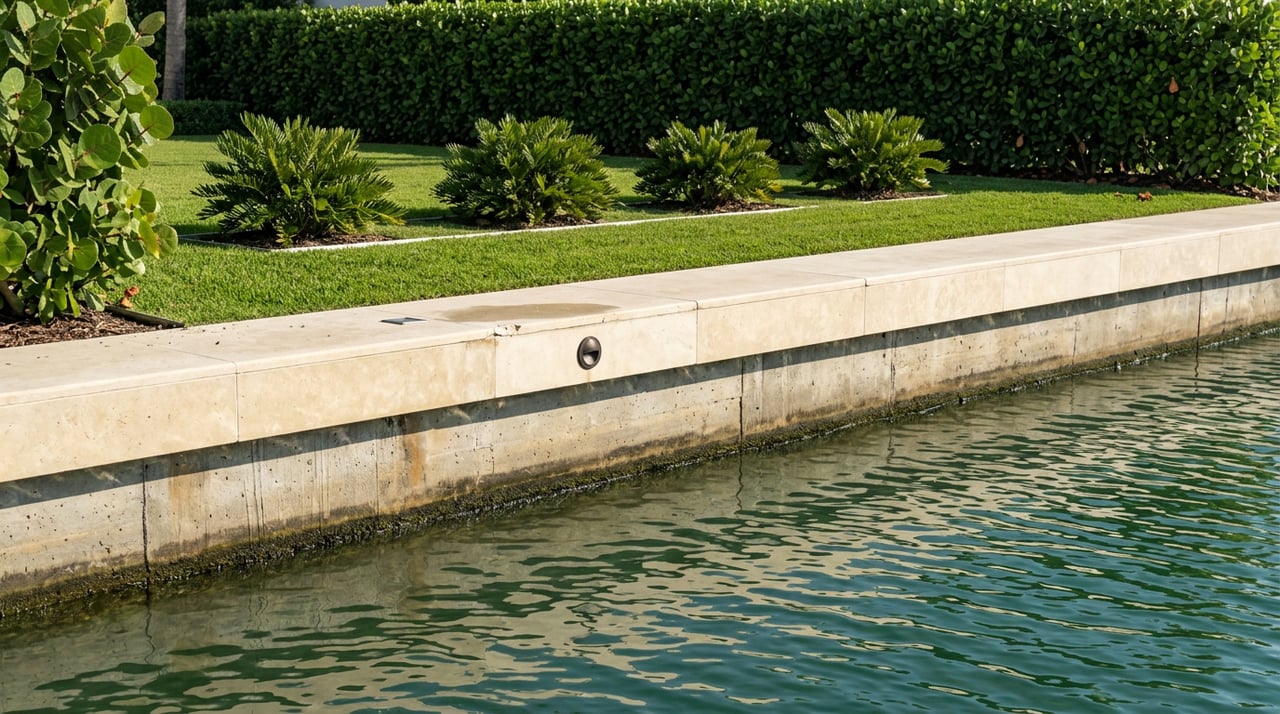
Aqualane Shores was platted in 1949 and the first homes were completed in 1950. A meaningful share of the seawalls in the neighborhood are on their second or third cycle. A qualified marine engineer can read the shoreline the way an appraiser reads comps: settlement at the cap, leaning panels, tieback corrosion behind the wall, toe scour at the waterline, and patch repairs without engineering behind them.
Each of those findings has a price. A tieback replacement on a canal-front lot is a permitted marine job that touches Collier County building, the Florida Department of Environmental Protection, and, depending on the scope, the U.S. Army Corps of Engineers. Sellers who arrive at listing with a recent engineering letter, a clean permit history, and documented tieback work carry that value into the sale sheet. Sellers who do not are now negotiating against a buyer who has read the same reports and priced the deficiency into the offer.
The city permit itself is inexpensive on paper. The City of Naples seawall permit is $100 plus a plan review fee equal to 35% of the permit fee, submitted through the city's electronic portal, with engineer-sealed drawings requiring a verifiable digital signature. What is expensive is the time. Bald eagle nesting season runs October 1 through May 15, which limits work windows on parcels near a nest, and any project that touches submerged land requires state coordination before the city will issue.
The canal depth question no listing sheet answers
The Aqualane brand is "deep water, no bridges." Both halves are true in the aggregate and unreliable at the parcel level. Canal depths in the neighborhood are commonly cited at eight to ten feet at mean low water, but the actual depth at your seawall face on a spring low tide is a specific number that only a survey will tell you. The canals here sit inside the West Naples Bay Special Taxing District, which manages dredging and canal maintenance from roughly 14th Avenue South to Galleon Drive. That district is why the neighborhood keeps its draft. It is also why buyers need to ask two questions before writing: when was the canal serving this parcel last dredged, and is a special assessment in front of it.
A parcel with a scheduled dredging cycle in the near term is a different property than one with unmaintained silt buildup and no assessment on the books. Same listing photograph. Different boat.
What findings actually do to an offer
The pattern we are seeing on 2026 contracts is that specific waterfront findings map to specific price and term movements. The below is directional, not a schedule, and every deal is negotiated on its own facts.
| Finding on inspection | Typical effect on the deal |
|---|---|
| Seawall with recent engineering letter, tiebacks documented | Supports list price, shortens contingency window |
| Cap settlement or leaning panels, no engineering on file | Repair credit or price adjustment tied to engineer estimate |
| Dock protrusion or setback out of compliance with § 5.03.06 | Buyer requests permit remediation or extension petition before close |
| Boat lift without stamped structural drawings on file | Post-close permit risk, often addressed with holdback or credit |
| Canal depth below buyer's vessel draft at MLW | Renegotiation, or contingency on dredging assessment schedule |
| Mangroves at shoreline with unresolved setback issue | Redesign of any planned dock work, potential FDEP coordination |
The through-line is that the waterfront file has moved from post-inspection cleanup to pre-offer strategy. Buyers who do the reading before writing are winning the parcels they want at prices sellers accept. Sellers who put the file together before listing are holding their number.
The sequence that protects a closing
The order in which a buyer commissions this work matters as much as the work itself. The sequence we recommend on Aqualane Shores contracts:
- Order a survey that shows mean high water, seawall face, and canal centerline before you finalize the offer, not after.
- Pull the permit history for the seawall, dock, boat lift, and any covered structures through the City of Naples portal, and confirm final inspections on each.
- Bring in a qualified marine or coastal engineer for a written seawall condition report with an estimated remaining service life.
- Confirm your intended vessel length, beam, and draft against Collier LDC § 5.03.06 protrusion and side setback rules at the specific canal width of the parcel.
- Check the dredging status of the specific canal segment with the West Naples Bay Special Taxing District, and ask about any assessment in queue.
- If any waterfront work is contemplated post-close, price the FDEP, county, and if applicable Army Corps timelines into your renovation schedule before you agree to a closing date.
A seller can run the same sequence in reverse. A listing that arrives at market with the survey, the permit file, the engineering letter, and a current canal depth reading is a listing that does not lose 105 days debating those questions with buyers one at a time.
Frequently asked questions
Does a City of Naples parcel need a Collier County permit for a new dock?
Yes. Every dock in Florida requires a Florida DEP authorization, and Collier County building permits cannot be issued for a dock facility until the DEP permit is in hand. City parcels also carry City of Naples building review. Depending on the scope, U.S. Army Corps of Engineers involvement can be triggered by waterway classification and mangrove setbacks.
If my dock is grandfathered, can I rebuild it as-is?
Not automatically. A significant rebuild is generally reviewed under current code. A repair or in-kind replacement may be treated differently. The specific test lives in the permit application and the plans reviewer's determination, which is why the permit history and any prior variances are worth pulling before you assume the footprint is portable.
How much does canal width actually change what I can moor?
A great deal. On a canal under 100 feet wide, the dock and vessel combined cannot exceed 25 percent of the width or 20 feet, whichever is smaller. On a 75-foot canal that is 18.75 feet total, dock and boat. Two feet of extra beam on the boat can push a compliant setup into a discretionary extension petition.
Is the seawall inspection different from a home inspection?
Yes. A residential home inspector is not typically qualified to write a seawall condition letter. The report you want comes from a marine or coastal engineer, addresses cap condition, panel alignment, tieback integrity, toe erosion, and remaining service life, and is the document your negotiation actually turns on.
Working the waterfront file with us
The Aqualane Shores market in 2026 rewards precision. The buyers who write with the survey and the permit file already in hand are the buyers getting to yes. The sellers who list with the shoreline documented are the sellers holding their price through a longer marketing window. If you are considering a purchase or a sale on the canals this year, The Beretta Group coordinates the marine engineers, permit research, and vendor introductions that turn a waterfront listing into a closed transaction. Schedule Your Consultation.